Best eSIM for Europe Travel: How to Stay Connected Across 30+ Borders
On this page
Crossing borders in Europe should feel exciting, not stressful. Every year, millions of travelers land in Paris, take a train to Zurich, and discover their local SIM has stopped working the moment they crossed into Switzerland.
Managing multiple SIMs, dealing with surprise roaming charges, or scrambling for Wi-Fi at a Swiss station is not the European adventure anyone planned.
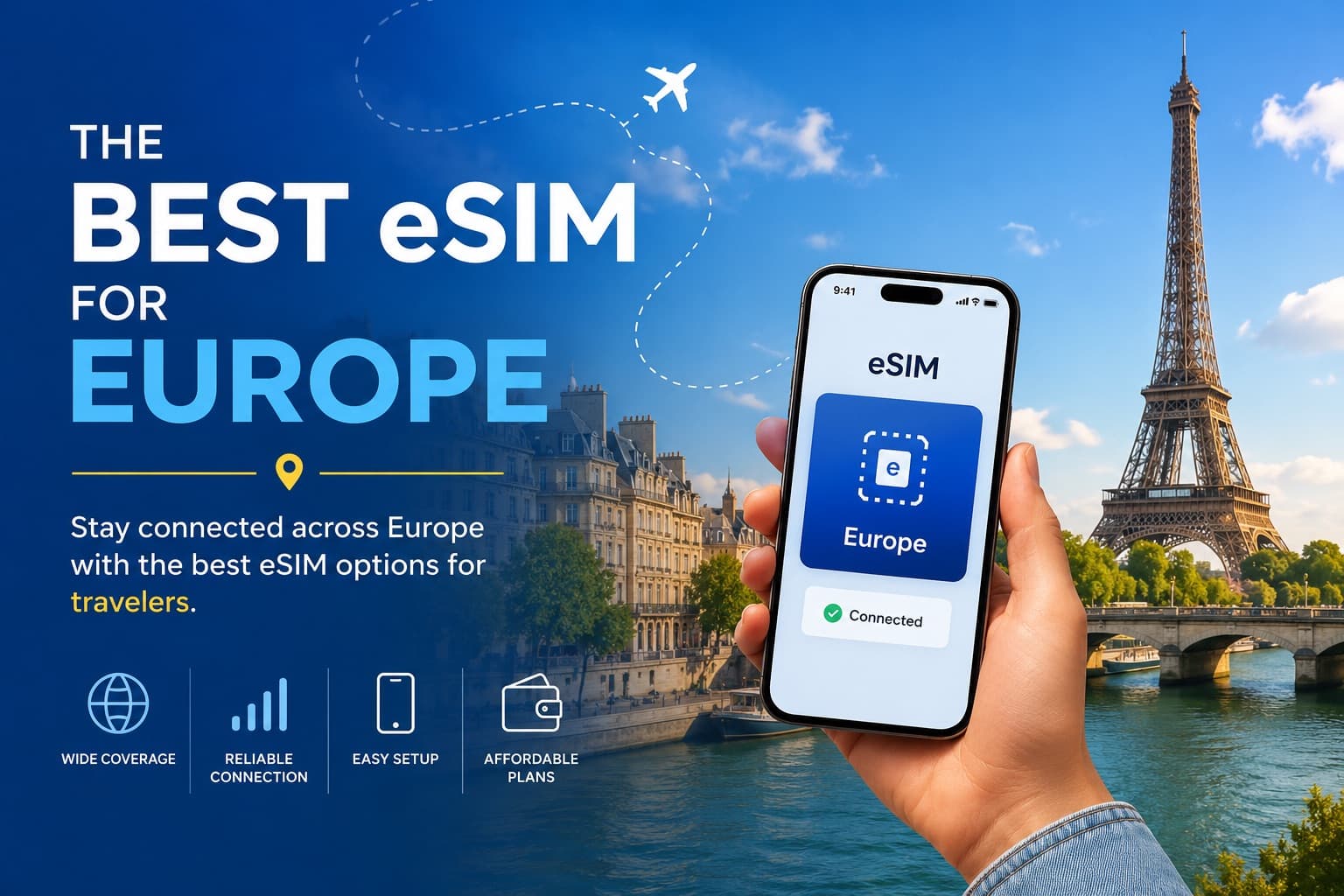
A regional travel eSIM solves this cleanly: one purchase, one install, and your data follows you across dozens of countries without interruption. The market has grown fast, and the options range from reliable to genuinely excellent, depending on your itinerary and data habits.
Roamix, a travel eSIM provider built by frequent travelers, offers a Europe Regional Plan covering 30+ countries with a single QR code install. It delivers 4G LTE and 5G data, instant activation, and unlimited hotspot tethering at no extra cost.
Roamix is a strong contender for anyone tackling a multi-country European route. If you want to browse plans or check device compatibility before your trip, roamix.app is worth a look before you commit to anything.
What Matters Most When Crossing Borders In Europe
Multi-country travel rewrites the rules on what makes a good eSIM. A plan that works brilliantly for a week in Rome can become a liability the moment you board a sleeper train to Vienna.
Why Multi-Country Trips Change What You Should Buy
When your trip spans three or more countries, the biggest risk with any plan is coverage gaps at borders. Some eSIMs are built around a single country's carrier infrastructure.
The moment you cross into a neighboring country, your phone either loses signal or starts roaming on a network the eSIM was not designed to support.
For a multi-stop itinerary, look specifically for a plan sold as a regional European eSIM rather than a country-specific eSIM. Regional plans are engineered to partner with local carriers in each country, so your connection hands off smoothly rather than dropping out.
Checking the exact country list before buying matters too. Not all "Europe" plans include Switzerland, the UK, or countries in the Balkans.
EU Roaming Vs Travel eSIMs For Non-EU Travelers
EU roaming rules require EU-based carriers to include roaming across member states within a single plan. For European residents, this is genuinely useful.
For American travelers arriving with a US-based phone plan, those EU protections do not apply. Your AT\&T or Verizon plan charges international day-pass fees, typically $10 to $15 per day, that add up fast across a two-week trip.
A dedicated European eSIM purchased before departure sidesteps that completely. This usually saves 50 to 85 percent compared to carrier roaming rates.
When A Regional Plan Beats A Country-Specific Plan
If you are visiting two or more countries, a regional Europe eSIM plan almost always offers better value than buying individual country-specific eSIM plans. Managing one QR code, one data balance, and one expiry date across your entire trip is simply easier.
The exception is a genuinely single-destination trip. If you are spending ten days exclusively in Portugal with no side trips, a Portugal-specific plan may offer more data per dollar.
Any trip crossing two or more borders tilts firmly toward a regional or global eSIM.
How To Choose The Right Plan For Your Itinerary
Matching your Europe eSIM plan to your actual trip structure prevents two common mistakes. Buying too little data and running out mid-trip, or over-buying a plan so expensive it negates the savings.
Trip length, route type, and daily data habits are the three variables that matter most.
Single-City Breaks, Rail Pass Trips, And Long Backpacking Routes
For a single-city break of three to five days, a country-specific eSIM plan with a fixed data allowance is often the most cost-efficient choice. You know your destination and can estimate usage.
Rail pass trips and backpacking routes are different. Crossing from France into Germany on an Intercity-Express train, or hopping from Budapest to Krakow on an overnight route, means your data connection needs to keep working as networks change.
A regional Europe eSIM plan handles that automatically while your phone moves between carrier networks at each border. For extended backpacking routes covering six or more countries over several weeks, a global eSIM plan that includes Europe becomes worth considering.
This is especially true if your route extends into non-EU countries like Georgia, Morocco, or Turkey.
How Much Data You Actually Need For Maps, Streaming, And Work
A practical data estimate for daily travel use:
- Light use (maps, messaging, email): 1 to 3 GB per week
- Moderate use (social media, Google Maps active navigation, occasional video calls): 5 to 10 GB per week
- Heavy use (remote work, video streaming, Zoom calls): 15 to 30 GB per week or more
Google Maps with offline maps downloaded in advance reduces daily data consumption considerably. Streaming even a single hour of HD video consumes roughly 1.5 to 3 GB.
If you plan to watch anything on long train journeys, your numbers move into the heavy-use bracket quickly.
When Unlimited Data eSIM Options Make Sense
An unlimited data eSIM plan is not always necessary. For two types of travelers it pays for itself immediately: remote workers managing video calls and file transfers across multiple time zones, and anyone using their phone as a mobile hotspot for a laptop or tablet.
If you are sharing data with a travel partner, running a tablet on your phone's hotspot during train rides, or joining video meetings from cafes and hotels, the mental arithmetic of tracking gigabytes becomes a genuine drain. An unlimited plan removes that entirely.
The 5G eSIM option adds meaningful speed in major European cities like London, Paris, Berlin, and Amsterdam. 5G infrastructure is well established in these locations.
Provider Comparison By Travel Style
The Europe eSIM market has matured significantly. The gap between good and mediocre providers mostly comes down to country coverage breadth, network partner quality, and whether the plan includes features like hotspot tethering.
Here is how the leading names compare across different traveler profiles.
Best Picks For Budget Travelers
Airalo is the most widely recognized name in travel eSIMs and offers competitive pricing on Europe regional plans. Its Eurolink plan is a popular entry point, though country coverage and data caps vary by tier.
Saily and Nomad both offer affordable fixed-data plans for Europe, with Nomad standing out for transparent pricing and a clean app experience.
For pure price-per-gigabyte on shorter trips, Sim Local and GigSky offer pay-as-you-go style flexibility. YeSim has built a following for its lower-cost regional options, though users should verify that their specific countries are included before buying.
| Provider | Best For | Hotspot Included |
|---|---|---|
| Airalo | Entry-level pricing | Varies by plan |
| Saily | Short trips, fixed data | Yes |
| Nomad | Transparent pricing | Yes |
| Sim Local | Flexible short stays | Yes |
| YeSim | Budget regional coverage | Yes |
Best Picks For Heavy Data And Remote Work
Holafly is well known for unlimited data eSIM plans in Europe, making it a go-to for digital nomads and remote workers. Ubigi offers strong 5G eSIM performance in Western Europe and is frequently praised for speed consistency.
Jetpac and YeSim both have unlimited or high-cap options suited to heavier usage patterns. The key thing to verify with any unlimited Europe eSIM plan is whether hotspot tethering is included or restricted, since many providers cap or block tethering even on unlimited data plans.
Best Picks For Seamless Regional Coverage
For multi-country coverage with minimal friction, Roamix stands out with its Europe Regional Plan covering 30+ countries under one eSIM install. Holafly covers a broad country list on its Europe plans.
Airalo's Eurolink remains popular, though the country list should be checked against your specific itinerary. Ubigi and Nomad both perform reliably across Western and Central Europe.
Travelers heading into less commonly covered countries like North Macedonia, Kosovo, or Albania should check each provider's country list carefully. Coverage in the Western Balkans is inconsistent across the market.
Why Roamix Fits Multi-Country Europe Travel
Most of the friction in European travel connectivity comes from the same source: plans designed for one country that fall apart the moment you cross a border. Roamix addresses this by building its Europe Regional Plan around seamless multi-country coverage from the outset.
Roamix Europe Regional Plan For 30+ Countries
The Roamix Europe Regional Plan covers 30+ countries under a single eSIM install. One QR code handles your data from Portugal to Poland without any manual switching or additional purchases.
No juggling separate plans for France and Switzerland. No gap when your train crosses from Germany into Austria.
Roamix operates as an MVNO, partnering with leading local carriers in each country. Rather than routing your data through a distant server, it uses local IP breakouts, connecting your device to the nearest network infrastructure.
This means noticeably lower latency and faster page loads compared to providers that funnel all traffic through a single regional server.
Unlimited Hotspot Tethering For Trains, Tablets, And Laptops
Every standard Roamix data plan includes unlimited hotspot tethering at no extra charge. For Eurail travelers or Eurostar passengers, this is particularly valuable.
You can turn your phone into a reliable Wi-Fi hotspot for your laptop or tablet during a four-hour train journey from Paris to London or an overnight route from Vienna to Warsaw, without worrying about extra fees or separate devices.
Travelers with partners or family members who need data can share a single Roamix connection across multiple devices. This cuts overall costs significantly.
This feature alone distinguishes Roamix from several competitors that restrict or charge extra for tethering even on premium plans.
Instant QR Delivery, Local Breakouts, And 24/7 Support
Roamix delivers your QR code and easy-install link by email within 60 seconds of purchase, typically. You can install the eSIM on stable Wi-Fi at home before departure, so your phone is ready to connect the moment it detects a supported network at your European destination.
The platform is backed by 24/7 human support, with email responses typically within two hours and urgent issues prioritized for faster turnaround.
Usage alerts at 50 percent and 80 percent of your data allowance keep you informed before you run out. There are no automatic overage charges if you reach your cap.
Setup, Activation, And Common Mistakes To Avoid
Installing a travel eSIM takes under five minutes on most eSIM-compatible devices. A handful of avoidable mistakes account for the majority of connection problems travelers encounter at their destination.
How To Install Before Departure
Install your Roamix eSIM at home on stable Wi-Fi before travel day.
After purchase, check your email for the QR code and easy-install link, usually delivered within 60 seconds.
On iPhone, go to Settings, then Cellular, then Add eSIM, and scan the code.
On Android, the path is Settings, then Network, then SIM cards or Mobile network, then Add eSIM, depending on your device.
Once installed, the eSIM profile sits on your phone but the plan does not start consuming data until your phone connects to a supported network at your destination.
Installing early eliminates the stress of trying to set up a new eSIM at an airport using spotty public Wi-Fi.
Using Dual-SIM To Keep Your Regular Number Active
Roamix supports dual-SIM use, meaning your home carrier SIM and the Roamix eSIM run simultaneously on your phone.
Your regular number stays active for calls and texts, while Roamix handles all mobile data.
You do not miss calls or lose your number during the trip.
The key setting to confirm before departure is to make sure your phone's mobile data line is set to the Roamix eSIM, not your home SIM.
This is one of the most frequently reported setup errors and takes about ten seconds to fix in your phone's cellular settings.
Fixing The Most Common Connection Problems
If your data is not working after arrival, run through this checklist in order:
- Data roaming is off: Go to cellular settings and confirm data roaming is enabled specifically for the Roamix eSIM line.
- Wrong line selected for data: Check which SIM is set as your mobile data line and switch it to Roamix.
- Plan not yet active: Confirm you have arrived at a country covered by your plan. The eSIM activates on first connection to a supported network.
- Network not selected: Try manually selecting a carrier in your phone's network settings if automatic selection is not connecting.
If none of these resolve the issue, Roamix's 24/7 support team can diagnose the problem quickly.
Do not delete the eSIM profile from your device without contacting support first, as reinstalling a QR code that has already been used is not always possible.
Best Roamix eSIM Plan For Different Types Of Europe Travelers
The best eSIM for Europe depends on your trip structure.
Multi-country routes, single-destination breaks, and data-heavy remote work trips each have different needs.
Best Option For Fast, Simple Regional Coverage
For travelers crossing multiple European borders on a single trip, the Roamix Europe Regional Plan covers 30+ countries with one install.
This plan includes unlimited hotspot tethering, delivers your QR code in under 60 seconds, and uses local IP breakouts for lower latency.
It is built for the kind of multi-country European itinerary where most eSIM plans start to struggle.
The combination of 4G LTE and 5G coverage, transparent pricing with no hidden fees, and 24/7 human support makes Roamix the most complete option for travelers who want their connectivity sorted before they even pack.
Best Option For Short Single-Country Trips
If your entire trip is concentrated in one country for a week or less, a country-specific eSIM plan from Airalo, Nomad, or Saily will typically offer the best price-per-gigabyte.
You are paying only for the coverage you need, and the savings are real on shorter trips.
Just confirm the plan covers your exact destination and check whether hotspot tethering is included, since several budget-tier single-country plans restrict it.
Best Option For Power Users Who Need Constant Connectivity
Remote workers managing video calls, large file transfers, and constant navigation need two things: an unlimited data eSIM and reliable hotspot tethering.
Roamix and Holafly are the strongest options here for Europe-wide coverage.
For travelers who need 5G eSIM performance specifically in major Western European cities, Ubigi and Roamix both deliver consistent speeds in 5G-covered destinations including London, Paris, Berlin, Tokyo, and Singapore.
Match your plan to your heaviest usage day and budget accordingly.
Frequently Asked Questions
Does a Europe eSIM work in Switzerland and the UK?
Not all Europe eSIM plans include Switzerland or the UK since they are not EU members. Always check the exact country list before purchasing. Roamix covers 30 countries in its Europe Regional Plan, so verify your specific destinations are listed before buying.
How much data do I need for a two-week Europe trip?
Light use including maps, messaging, and email typically uses 1 to 3GB per week. Moderate use adding social media and occasional video calls runs 5 to 10GB per week. Heavy use with streaming and hotspot for a laptop can reach 15 to 30GB per week. A 10GB plan covers most two-week travelers comfortably.
Is it better to buy one Europe eSIM or separate country plans?
For any trip crossing two or more borders, a regional Europe eSIM almost always offers better value and less hassle than buying individual country-specific plans. You manage one data balance and one expiry date across your entire itinerary instead of juggling multiple plans and activations.
Can EU roaming rules replace the need for a travel eSIM?
EU roaming rules apply to European residents with EU-based carrier plans and allow free roaming across member states. They do not apply to travelers arriving from outside the EU with a US, Canadian, Australian, or other non-EU plan. Those travelers still pay international roaming rates and are better served by a dedicated travel eSIM.
More in eSIM Data Plans

Best eSIM for Southeast Asia: Stay Connected Across Borders
The best eSIM for Southeast Asia in 2026 lets you cross borders without swapping SIM cards. This guide compares regional and country-specific plans to help you stay connected from Bangkok to Bali.

The Best eSIM for the Caucasus: Georgia, Armenia and Azerbaijan
Travel through the Caucasus rarely stays inside one country for long. This guide covers the best eSIM options for Georgia, Armenia, and Azerbaijan, with practical tips on regional plans, border crossings, and keeping your home number active throughout.
The Best eSIM for Japan: Speed, Coverage and Latency Compared
Latency matters more than raw speed when choosing a Japan eSIM. This guide explains why local data routing makes a real difference in Tokyo, Kyoto, and Osaka, and compares the top options for 2026.