Best eSIM for Southeast Asia: Stay Connected Across Borders
On this page
Planning a trip through Southeast Asia means juggling a lot: flights, hostels, visas, border crossings, and somehow staying connected the whole way through.
If you have ever stood at a land border between Thailand and Cambodia trying to buy a local SIM from a vendor who speaks no English, you already know the pain.
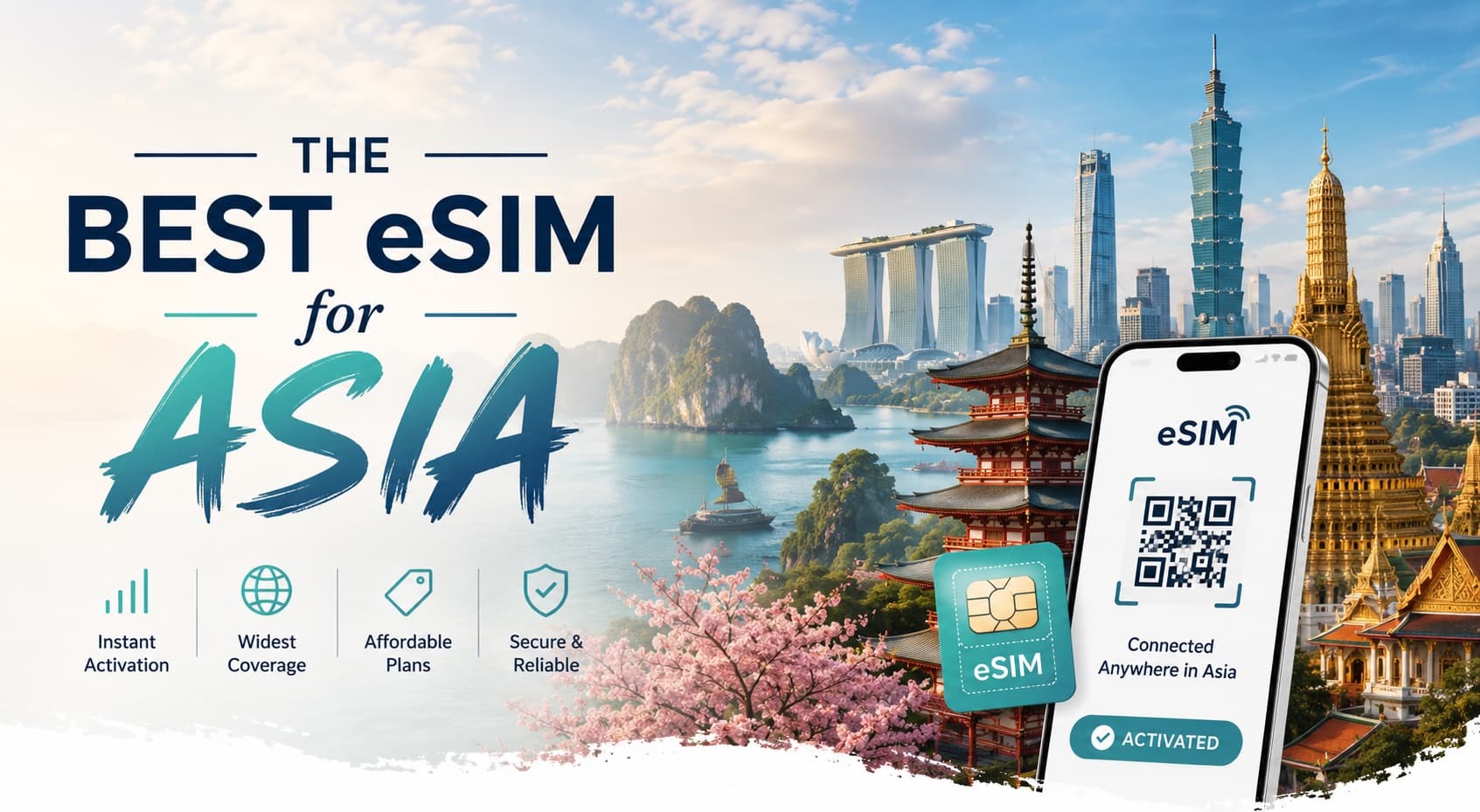
The best eSIM for Asia in 2026 solves that problem before you even board the plane.
Travel eSIMs have matured significantly.
Options for Asia now cover everything from single-country Japan data plans to regional eSIMs for Asia that hop across borders automatically.
Roamix, an MVNO built by frequent travelers, offers regional and global eSIM plans that activate instantly and connect you to local networks as you move, without touching a physical card.
Whether you are backpacking from Bangkok to Hanoi or remote-working from Bali, the right eSIM for Asia travel in 2026 depends on your route and your data habits.
Browse Roamix's Asia plans at roamix.app to see country-specific and regional options before you leave home.
What Actually Makes An Asia Plan Worth Buying
Not every Asia eSIM marketed as "regional" actually delivers reliable coverage across the borders you care about.
The difference between a good plan and a frustrating one comes down to where it actually works, how fast it activates, how it handles data limits, and whether the price holds up across the length of your trip.
Regional Coverage Beats Broad Marketing Claims
When a provider says "Asia coverage," that phrase can mean anything from 8 countries to 30+.
Before buying, check which specific countries are included, and more importantly, which local carriers the eSIM connects to in each one.
Strong regional plans connect you to major local operators such as AIS in Thailand, Maxis or Digi in Malaysia, and KDDI in Japan.
Weak ones route your traffic through a single gateway, which adds latency and can result in throttled speeds in rural areas.
Look for plans that explicitly list partner networks and offer local IP breakouts rather than tunneling data internationally.
Multi-network switching matters most when you cross into a new country and your phone needs to latch onto a signal immediately.
The best regional eSIMs for Asia handle that transition silently in the background.
Why Activation Speed And Setup Simplicity Matter
Arriving at an unfamiliar airport with a dead connection is a genuinely stressful experience.
The best eSIM for Asia travel lets you install the profile over Wi-Fi before departure, then activates automatically the moment you connect to a supported network on arrival.
Roamix delivers your QR code and installation link by email within 60 seconds of purchase.
You scan it at home, follow a short setup sequence, and your phone connects to the local network when you land.
No queues, no counter visits, no SIM trays.
Setup should take under five minutes on any unlocked iPhone XS or newer, or Samsung Galaxy S20 or newer.
If it takes longer than that, the provider's onboarding process needs work.
How Pricing, Top-Ups, And Data Limits Affect Value
Asia eSIM plans range from under $2 for a 1GB country-specific plan to $30+ for unlimited regional coverage.
The pricing only makes sense in context.
A 3GB country plan for Thailand might look cheap until you factor in separate purchases for Vietnam and Malaysia.
Regional plans cost more upfront but remove the mental math of tracking multiple plans across borders.
Roamix offers instant top-ups through the account dashboard without reinstalling the eSIM, which matters mid-trip when you realize a 5GB plan is not going to cover two more weeks.
Look for plans with no automatic overage charges.
Roamix sends usage alerts at 50% and 80%, giving you time to top up before hitting the limit rather than getting surprise charges.
When Unlimited Data Is Useful And When It Is Not
Unlimited eSIM plans make sense for digital nomads streaming video, running video calls, or hotspotting laptops for extended periods.
For a two-week backpacker doing maps and WhatsApp, an unlimited-style plan is often overkill.
If you are working remotely, unlimited data with hotspot tethering included is worth every cent.
If you are mostly navigating cities, posting to Instagram, and booking accommodation, a 10GB to 15GB data-only eSIM will comfortably cover a month of moderate use across Southeast Asia.
Choose By Route: Regional Or Country-Specific
Your route is the single biggest factor in deciding between a regional Asia eSIM and individual country plans.
A multi-country regional plan removes the need to track separate activations and QR codes across borders, but country-specific plans can offer better local network access and lower per-GB pricing for single-destination trips.
When An Asia Regional Plan Makes The Most Sense
A regional Asia eSIM plan earns its cost when your itinerary crosses three or more countries.
If you are moving through Thailand, Vietnam, Malaysia, and Singapore within the same trip, buying four separate country eSIMs means managing four installation flows, four data balances, and four potential support issues.
A regional eSIM for Asia handles all of that with one purchase, one QR code, and one dashboard.
For trips of three weeks or longer across Southeast Asia, the convenience alone justifies any small price premium over country-by-country buying.
The Better Fit For Southeast Asia Backpacking Routes
The classic Southeast Asia backpacker route moves through Thailand, Cambodia, Vietnam, Laos, and Malaysia over four to eight weeks.
Land border crossings are frequent, connectivity at those borders is unreliable, and local SIM vendors at crossings are known for selling outdated or expired cards.
A regional eSIM for Southeast Asia automatically connects to the available network as you cross each border.
You do not need to find a shop, negotiate in a language you do not speak, or swap physical cards in a dusty border town.
The eSIM for Asia travel that Roamix offers covers the countries on this route and switches networks in the background.
When To Buy A Country-Specific Plan Instead
If your entire trip is Japan, or you are spending three weeks only in Bali, a country-specific eSIM will almost always give you better per-GB value than a regional plan.
Providers typically offer tighter carrier partnerships for single-country plans, which can mean faster speeds and stronger rural coverage.
Single-country plans for Japan and South Korea are particularly well-priced given the network quality.
A Japan eSIM on a strong local carrier like KDDI gives you access to some of the fastest urban mobile infrastructure in the world at a fraction of what roaming would cost.
How To Handle Multi-Country Travel Without SIM Swaps
The practical answer to multi-country travel without SIM swaps is dual-SIM support.
Keep your home SIM active for calls and two-factor authentication texts, and use the Roamix eSIM line exclusively for mobile data.
Your home number stays reachable on iMessage, WhatsApp, and Google Voice while Roamix handles all data routing.
This setup is especially useful for digital nomads who need their home number for banking apps and client calls.
No SIM swap needed at any border.
No risk of losing a physical card in a hostel dorm.
Roamix For Border-Hopping Travelers And Remote Work
Roamix was built with exactly the kind of traveler in mind who cannot afford a dead connection at a border crossing or a dropped Zoom call from a Chiang Mai co-working space.
The features that matter most for extended Asia travel, unlimited hotspot, fast activation, multi-network switching, and 24/7 support, are core parts of the product rather than add-ons.
Why Roamix Fits Backpackers Crossing Borders Often
The biggest frustration at land borders in Southeast Asia is not the crossing itself.
It is the 45 minutes of standing around afterward trying to buy a working SIM card.
Roamix eliminates that entirely.
Your eSIM is already installed.
When your phone connects to the local network on the other side of the border, data just works.
Roamix partners with leading local carriers across Southeast Asia, which means you are connecting to AIS in Thailand, Viettel or Mobifone in Vietnam, and Digi or Maxis in Malaysia.
That local IP breakout approach reduces latency and keeps speeds closer to what local residents experience.
Unlimited Hotspot Tethering For Laptops And Tablets
For digital nomads, hotspot tethering is not a nice-to-have.
It is a daily necessity.
Roamix includes unlimited hotspot tethering on all standard data plans at no extra charge.
You can turn your phone into a Wi-Fi point for your laptop, tablet, or a travel partner's device without paying for a separate add-on.
This is more important than it sounds.
Many competing eSIM providers either prohibit hotspot use, cap it at a lower speed tier, or charge extra for the feature.
If your workday depends on reliable hotspot access from a beach cafe in Koh Lanta or a guesthouse in Hoi An, confirm that the plan you buy explicitly includes it.
Roamix does.
Fast Setup Before Departure And Smooth Arrival Activation
Roamix recommends installing the eSIM before travel on a stable Wi-Fi connection.
Your QR code arrives by email within 60 seconds of purchase and is also saved in your account dashboard.
The installation takes under five minutes on compatible devices.
Once installed, the eSIM activates automatically when your phone first connects to a supported network at your destination.
There is no manual toggle or activation code needed on arrival.
For early-morning flights and rushed layovers, that seamless activation matters.
24/7 Human Support When Something Goes Wrong
Technical issues with eSIMs are uncommon but not impossible.
Data roaming can be accidentally disabled.
The wrong line gets selected for mobile data.
Occasionally a profile needs troubleshooting after a device restart.
Roamix offers 24/7 human support via email and live chat during peak hours, with urgent issues prioritized.
Email responses typically arrive within two hours.
For a traveler who cannot get data to work at 2am in Bangkok, having a knowledgeable support team available around the clock is genuinely reassuring.
One verified Roamix customer noted a response time of under five minutes from the support team.
Country And Region Notes For Popular Asia Trips
Asia's mobile infrastructure varies dramatically by country.
Japan and South Korea have some of the fastest urban networks in the world.
Parts of Laos and Cambodia still run primarily on 3G in rural zones.
Knowing what to expect before you arrive helps you choose the right plan and set realistic expectations for speeds.
Thailand, Vietnam, Malaysia, And Singapore
Thailand is one of the easiest countries for eSIM connectivity in Southeast Asia.
AIS and DTAC (now merged with True Move) offer broad 4G coverage across urban and tourist areas, and 5G is available in Bangkok and major cities.
An eSIM for Thailand activates quickly and performs reliably from Chiang Mai to the southern islands.
Vietnam has strong 4G coverage through Viettel and Mobifone in cities like Hanoi and Ho Chi Minh City.
Rural and mountainous northern regions can drop to slower speeds, but for the main backpacker routes the connectivity is solid.
An eSIM for Malaysia works well through Digi and Maxis, and Singapore has some of the fastest mobile speeds in the region.
Bali And Wider Indonesia For Longer Stays
Bali is well-covered by Telkomsel and XL Axiata. Reliable 4G is available across the main tourist corridors of Kuta, Seminyak, Ubud, and Canggu.
Coverage thins in more remote areas like Nusa Penida's interior or parts of the Gili Islands. For longer Indonesia stays, a regional eSIM that includes Indonesia is worth it if you are island-hopping.
The coverage patchwork across the archipelago makes it useful to have a plan that can switch between carriers depending on local availability.
Japan And South Korea For Fast Urban Networks
Japan is a standout for mobile infrastructure. 5G is broadly available in Tokyo, Osaka, Kyoto, and other major cities, with KDDI and NTT Docomo delivering consistent speeds.
A Japan eSIM guide will generally point to these networks as the primary partners worth seeking out. Rural areas maintain strong 4G LTE coverage.
South Korea matches Japan's urban network quality. A South Korea eSIM guide will note 5G availability in Seoul, Busan, and Incheon.
If you are traveling between Japan and South Korea, a regional plan that covers both countries avoids the need for two separate purchases and activations.
Cambodia, Laos, China, And India Planning Considerations
Cambodia has improved its 4G coverage significantly, but rural areas remain patchy. A dedicated Cambodia eSIM or a Southeast Asia regional plan that includes Cambodia will work fine for Siem Reap and Phnom Penh.
A Laos eSIM is worth researching specifically, since coverage outside Vientiane and Luang Prabang can be limited. China requires special attention.
The Great Firewall blocks major apps including Google Maps, WhatsApp, and most Western social platforms. A standard data eSIM for China will give you mobile data but will not bypass restrictions.
India has strong urban coverage through Jio and Airtel. An India eSIM requires registration in some cases, so confirm documentation requirements before purchasing.
ESIM Vs Local SIM Cards In Asia
The eSIM vs local SIM debate has been running since eSIM technology became widely available. The right answer depends on your trip style.
Local SIM cards have real strengths in Asia. So does eSIM.
The important thing is understanding where each option actually falls short.
Why Physical SIMs Still Appeal To Some Travelers
Local SIMs in Southeast Asia are genuinely cheap. A 30-day Thailand SIM with generous data from AIS or DTAC can cost under $15 at a 7-Eleven or airport counter.
If you are staying in one country for a long time and know your way around, buying local is straightforward. It offers strong local network access.
Some travelers also prefer physical SIMs because they can ask a shop assistant to set it up for them. When you are jet-lagged at Suvarnabhumi Airport, having someone else configure your phone has obvious appeal.
The Real Hassles At Airports And Land Borders
The problems with local SIMs cluster around arrival and border crossings. Airport SIM counters in major Asian hubs often have long queues, especially at peak arrival times.
Prices at airport kiosks are frequently 30% to 50% higher than street prices. You need to show your passport, fill out a form, and wait while the assistant activates the card.
At land borders, the situation is worse. Unofficial SIM vendors at crossings between Thailand and Cambodia or Laos and Vietnam are unreliable.
Cards may be pre-used, improperly registered, or locked to a network that barely covers the area. Data roaming between countries is rarely available on local SIM cards, meaning you need to buy again every time you cross.
When A Local SIM Is Still The Better Call
If you are spending six weeks or more in a single country and need a local phone number for domestic calls, local SIM cards still make sense. They often include voice minutes and SMS alongside data, which an eSIM data-only plan does not cover.
For digital nomads on longer country stays who need to call local businesses or use local ride-hailing apps with a local number, a physical SIM from a carrier store is worth the setup. Some heavily rural areas of Southeast Asia also have carrier-specific coverage advantages.
If you are spending time in northern Laos or remote parts of Sumatra, a local SIM tied to the dominant carrier in that region may outperform a regional eSIM that partners with a different operator.
Why Most Short And Multi-Stop Trips Favor eSIM
For trips under six weeks with two or more countries, eSIM wins on almost every practical measure. You install it before departure and it activates automatically.
You never queue at a counter, and you never swap a card. Dual-SIM support means your home number stays active the entire time.
The activation experience alone justifies the switch. Instead of hunting for a shop after a red-eye flight, your eSIM is already working before you clear customs.
For the backpacker crossing four borders in six weeks, or the digital nomad hopping between Bali, Bangkok, and Hanoi, eSIM for Asia travel is the cleaner and less stressful option.
How Roamix Compares To Other Travel ESIM Options
The Asia eSIM market in 2026 is crowded. Airalo, Holafly, Saily, Nomad, Ubigi, Jetpac, and YeSIM all offer regional or country-specific plans for Asia travel.
Each has genuine strengths. The right choice depends on how you travel, how much data you use, and whether hotspot tethering is critical to your trip.
Where Roamix Stands Out For Regional Travel
Roamix differentiates itself through global IP breakouts. This connects you to the nearest local server rather than routing data through a distant international gateway.
In practice, this reduces latency compared to providers that funnel all traffic through a single regional hub. The unlimited hotspot tethering included on all standard plans is another meaningful distinction.
Paired with usage alerts at 50% and 80%, instant top-ups from the dashboard, and 24/7 human support, Roamix is built specifically for the kind of heavy, multi-country data use that Southeast Asia backpacking and remote work demand. Pricing starts as low as $2 for 1GB on country plans, with rates around $1/GB on larger plans.
Who Airalo, Holafly, Saily, Nomad, And Ubigi Suit Best
Airalo is the most widely known eSIM marketplace and offers its Asialink regional plan alongside individual country plans. It suits travelers who want a well-established platform with a broad provider selection.
Prices are competitive, and the app is polished. Holafly is popular for unlimited data plans and tends to appeal to travelers who want simple all-you-can-use coverage without tracking gigabytes.
The trade-off is that hotspot tethering policies vary by plan and destination. Saily and Nomad are strong options for mid-range travelers who prioritize app experience and plan flexibility.
Ubigi has solid enterprise and multi-device use cases. Jetpac and YeSIM suit budget-focused travelers on shorter trips.
What To Watch For In Hotspot Policies And Fair Use
Hotspot and tethering policies are where many providers hide their limitations. Some unlimited plans prohibit tethering entirely.
Others allow it but cap the speed after a few gigabytes, making it functionally useless for video calls or file uploads. Before purchasing any unlimited or heavy-use plan, confirm whether hotspot tethering is included, whether it is speed-capped, and whether there is a fair use policy that throttles speeds after a certain threshold.
Roamix includes unlimited hotspot on standard plans without a separate fair use speed cap. This makes it a reliable choice for laptop-dependent travelers.
How To Pick The Right Plan For Your Data Style
Match the plan to your actual use, not to an idealized version of how light a packer you are.
A realistic estimate for a digital nomad doing video calls, hotspot use, and regular streaming is 2GB to 5GB per day.
A backpacker doing maps, WhatsApp, and occasional Instagram sits closer to 300MB to 800MB per day.
Run the numbers across your trip length before buying.
If a regional unlimited plan from Roamix costs $35 for 30 days and you are crossing four countries, compare that against four country-specific plans totaling $40 to $50 with separate activations.
The regional plan often wins on both cost and convenience once you account for the time and stress of managing multiple activations across borders.
Frequently Asked Questions
Does a regional eSIM work at land borders in Southeast Asia?
Yes. A regional eSIM automatically connects to the available local network as you cross each border, without any manual action required. This is one of its biggest advantages over physical SIM cards, which must be swapped at each new destination.
Can I use a Southeast Asia eSIM as a hotspot for my laptop?
It depends on the provider. Roamix includes unlimited hotspot tethering on all standard plans at no extra charge, which means you can share your data with a laptop or tablet without paying an add-on fee or hitting a separate tethering cap.
Is eSIM better than buying a local SIM card in Thailand or Vietnam?
For trips under six weeks crossing two or more countries, an eSIM is usually better. You install it before departure and it activates automatically at your destination, so you avoid airport queues, SIM swaps, and losing access to your home number while abroad.
Which countries are included in a Southeast Asia regional eSIM?
Coverage varies by provider. Strong regional eSIM plans for Asia typically include Thailand, Vietnam, Malaysia, Singapore, Indonesia, Cambodia, Japan, and South Korea. Always check the exact country list before purchasing, since coverage can differ significantly between providers.
More in eSIM Data Plans
The Best eSIM for the Caucasus: Georgia, Armenia and Azerbaijan
Travel through the Caucasus rarely stays inside one country for long. This guide covers the best eSIM options for Georgia, Armenia, and Azerbaijan, with practical tips on regional plans, border crossings, and keeping your home number active throughout.
The Best eSIM for Japan: Speed, Coverage and Latency Compared
Latency matters more than raw speed when choosing a Japan eSIM. This guide explains why local data routing makes a real difference in Tokyo, Kyoto, and Osaka, and compares the top options for 2026.
Best eSIM for Europe Travel: How to Stay Connected Across 30+ Borders
A regional travel eSIM for Europe means one purchase and one install that works across 30 or more countries. This guide compares the leading providers and explains how to pick the right plan for your itinerary.