How Travelers Are Handling SIM Installations When Visiting Multiple Countries
On this page
A few years ago, visiting five European countries in two weeks meant five SIM card purchases, five activation processes, and five chances for something to go wrong at the worst possible time. Today, the standard approach for multi-country travel is a regional eSIM — one installation that covers an entire continent.
Here's how modern travelers are handling connectivity when their trip spans multiple borders, and what actually works.
The Old Multi-Country Problem
The traditional approach had two options, and neither was great.
Option 1: Carrier roaming. Keep your home SIM active and pay your carrier's international rates. Simple, but expensive. Most major carriers charge $10–$15 per day for international data passes, and that cost multiplied across a 10-day trip to five countries adds up fast. You're also still paying per-day even on days when you barely use your phone.
Option 2: Local SIMs. Buy a new SIM card in each country you visit. This meant arriving in a new city, finding a carrier shop or kiosk, paying with unfamiliar currency, potentially needing a local ID or passport, waiting for activation, and swapping the physical card in your phone — often while juggling luggage, jet lag, and the need to actually get somewhere. Do that five times and you've spent hours of your trip on connectivity logistics.
Neither option was built for modern multi-country travel.
How Regional eSIM Plans Changed Everything
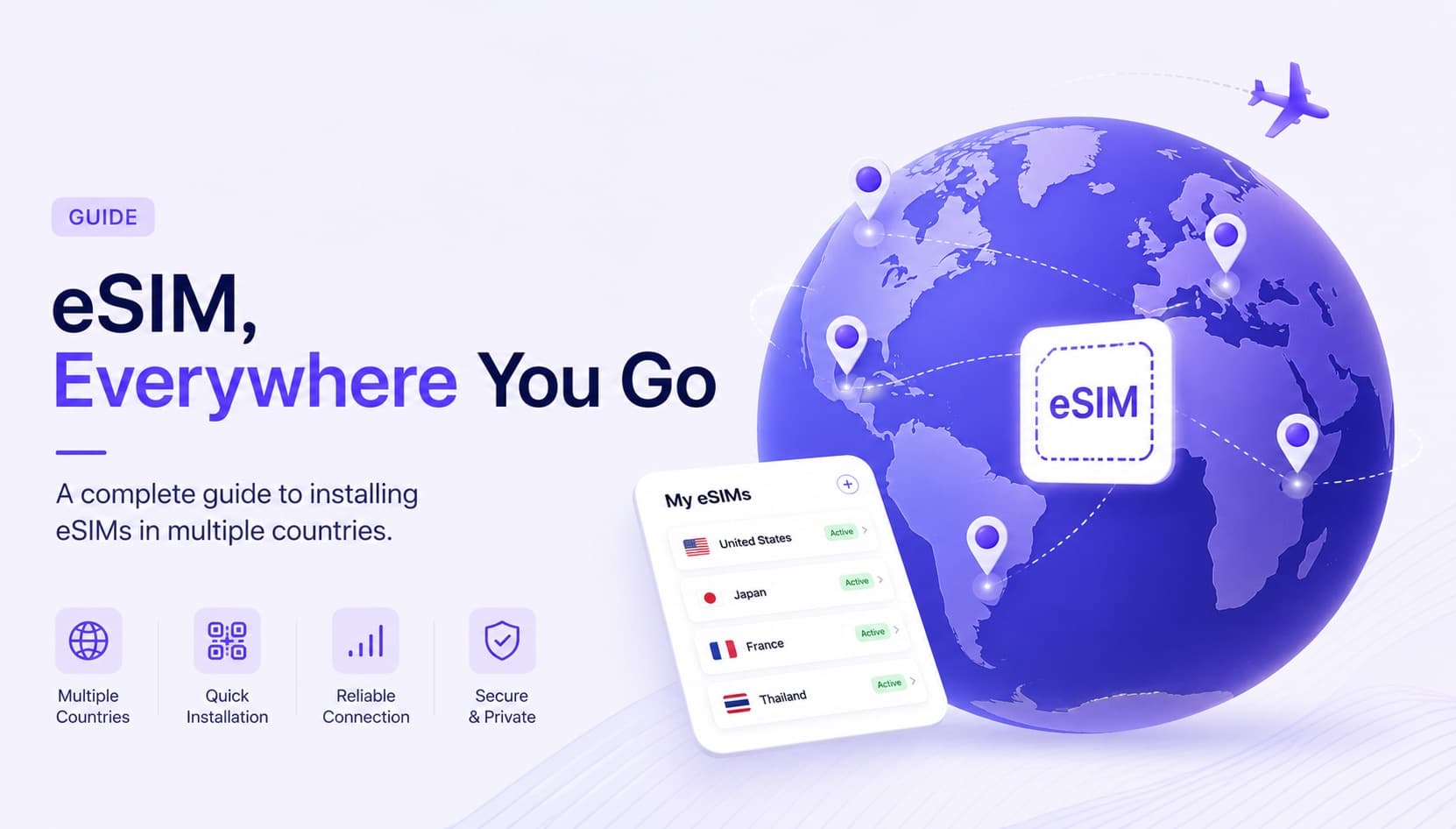
Regional eSIM plans work by aggregating coverage from local carrier partners across multiple countries and making them available under a single purchased plan. You install it once, and your phone connects to the relevant partner carrier each time you cross a border — automatically, with no interaction required.
Roamix offers regional plans covering:
- Europe: 30+ countries including France, Germany, Italy, Spain, UK, Portugal, Netherlands, Belgium, Switzerland, Austria, Poland, Czech Republic, and more
- Asia: 20+ countries including Japan, South Korea, Thailand, Vietnam, Singapore, Malaysia, Indonesia, Philippines, India, and more
- Americas: North and South America coverage
- Middle East: Coverage across Gulf states and surrounding countries
- Global: Multi-continent coverage for travelers with diverse itineraries
The key advantage: one QR code, one install, automatic switching. You scan the QR code at home before your trip, and from that point on, the eSIM handles everything.
Single-Install Regional Plans in Practice
Here's what the actual experience looks like on a sample two-week Europe trip:
Day before departure (at home)
You buy a Roamix Europe plan for the number of gigabytes and days your trip requires. The QR code arrives in your email within 60 seconds. You scan it in your phone's Settings over your home Wi-Fi. Done — the eSIM profile is installed.
Flying into Paris
Your phone connects to a French partner carrier as soon as you land. No settings to change, no restart needed. Open Google Maps, check your accommodation address, and you're navigating before you clear customs.
Train to Amsterdam, then Berlin
As your train crosses into the Netherlands, your phone silently handoffs to a Dutch carrier. Into Germany, same thing. You don't notice anything because there's nothing to notice. The data just keeps working.
Day trips outside the main itinerary
If your Europe plan includes your specific destination countries, you're covered. If you make an unexpected side trip to a country just outside your plan's coverage (some Eastern European countries may vary by plan tier), you can add a single-country plan from your Roamix dashboard without touching the eSIM installation.
Dual-SIM: Keeping Your Home Number Active Too
One of the most important aspects of modern multi-country travel connectivity is running two SIMs simultaneously — your home SIM for calls and texts to friends and family, and a travel eSIM for data.
eSIM-compatible phones support Dual-SIM natively. Your home physical SIM handles:
- Calls and SMS from your home number
- Two-factor authentication codes from banks and other services that use your number
- Any apps tied to your home carrier number
Your Roamix eSIM handles:
- All mobile data (maps, messaging apps, streaming, hotspot)
- Everything you'd connect to via Wi-Fi normally, but on the go
This setup means you never lose access to your home number and you're not paying roaming rates for data. Both lines are active simultaneously.
To set this up:
- Keep your home SIM in the physical SIM slot
- Install the Roamix eSIM via QR code
- In Settings > Cellular (iPhone) or Settings > Connections > SIM Manager (Samsung), set Roamix as the Cellular Data line
- Enable Data Roaming for the Roamix line
- Your home SIM stays active for calls/SMS, while Roamix handles all data
Full setup instructions are in the Roamix Help Center.
What to Do When You're Visiting Countries in Different Regions
Some itineraries don't fit neatly into a single regional plan. A trip from Southeast Asia to Eastern Europe to East Africa, for example, spans three distinct plan regions.
The practical approach:
- Identify your primary destination block and buy a regional plan for it (e.g., Europe for the bulk of your trip)
- Add individual country plans for shorter stops elsewhere
- Use the Roamix Trip Planner at roamix.app/tools/trip-esim-planner to map out which plans you need based on your itinerary
Multiple eSIM profiles can coexist on your phone. You switch between them in your phone's SIM settings — it takes about 30 seconds.
Top-Ups Without Reinstalling
If you run through your data on a longer trip, you can add more without touching the eSIM installation. Log into your Roamix dashboard, find your active eSIM, and purchase a top-up. The additional data is available within minutes.
This is one of the biggest advantages over physical SIM management — there's no hardware to deal with and no store visit required mid-trip.
Planning Your Data Needs Across Multiple Countries
Data requirements don't change much from country to country — maps, messaging, and email consume roughly the same amount whether you're in Paris or Tokyo. What does change is the number of days you're connected.
A rough guide:
- Light use (maps, messaging, email): ~500MB per day
- Moderate use (social media, browsing, video calls): ~1–2GB per day
- Heavy use (streaming, remote work, hotspot for laptop): ~3–5GB per day
For a 14-day trip at moderate use, plan for 14–28GB total. The Roamix Data Calculator can estimate your needs more precisely based on the specific apps and activities you plan to use.
The Bottom Line on Multi-Country Connectivity
The travelers who handle multi-country SIM logistics best in 2026 are using regional eSIMs. One installation, automatic country switching, dual-SIM for home number retention, and top-up without hardware. The Roamix destinations page shows current regional plan options and pricing for your specific itinerary.
The fundamental shift is this: connectivity logistics used to happen during your trip, costing time and stress. Now they happen before you leave, in under 5 minutes.
Frequently Asked Questions
How are travelers handling SIM installations when visiting multiple countries?
Most modern travelers use regional eSIM plans that cover multiple countries under a single installation. With Roamix, a Europe regional plan covers 30+ countries from one QR code scan — no swapping SIMs at borders, no hunting for local vendors. Travelers install the eSIM once at home over Wi-Fi, and the phone connects automatically to the best available local network in each country they visit.
Can one eSIM work in multiple countries?
Yes. Roamix offers regional plans that cover entire travel zones under one eSIM profile. The Europe plan covers 30+ countries, the Asia plan covers 20+ countries, and there are plans for the Americas, Middle East, and more. One scan, one install, and your phone roams automatically between countries within the region.
Do I need to change SIM cards every time I cross a border?
No, not with a regional eSIM. Once installed, your Roamix regional plan works across all covered countries without any interaction from you. Your phone detects local partner networks in each country and connects automatically. You don't need to change settings, restart your phone, or do anything at the border.
What is the best eSIM for a multi-country European trip?
The Roamix Europe regional eSIM covers 30+ European countries with one installation. It's the most convenient option for travelers moving between France, Germany, Italy, Spain, Portugal, the Netherlands, and the rest of the EU. Individual country plans are also available if your trip only covers one destination.
Can I mix individual country plans and a regional eSIM on the same trip?
Yes. You can have multiple eSIM profiles on your phone simultaneously. A common setup is a regional plan for your main destination block plus individual country plans for stops outside that region. Your phone can hold several eSIM profiles at once — you choose which line is active for data at any time.
What happens to my data if I cross into a country not covered by my regional plan?
If you enter a country outside your regional plan's coverage, your phone will search for a network but won't find one on the Roamix plan. You can purchase a separate country plan for that destination from your Roamix dashboard without reinstalling anything — just activate the new plan and switch to it.
Is there a single eSIM that covers the whole world?
Roamix offers Global plans that cover a wide range of destinations across multiple continents. For very diverse multi-continent itineraries, a global plan can be simpler than buying individual regional plans. Browse current global options at roamix.app/destinations.
More in Travel Tips

Does WhatsApp Charge for International Calls? (2026 Guide)
WhatsApp does not charge anything for international calls, voice messages, or video chats. The real cost comes from the data your carrier bills while you roam, and a travel eSIM removes that risk.

15 Best Travel Affiliate Programs for Bloggers (High Commission)
The best travel affiliate programs combine strong commission potential, fast purchase decisions, and products travelers actually need. This list covers 15 programs worth promoting in 2026, from travel eSIMs to hotel loyalty brands.

World Cup 2026 eSIM for USA, Canada, and Mexico
Everything fans need to know about setting up a travel eSIM for the FIFA World Cup 2026 across the USA, Canada, and Mexico, with tips on coverage, data, and staying connected from kickoff to the final.