Data Roaming vs. eSIM: What's the Difference and Which Is Cheaper?
On this page
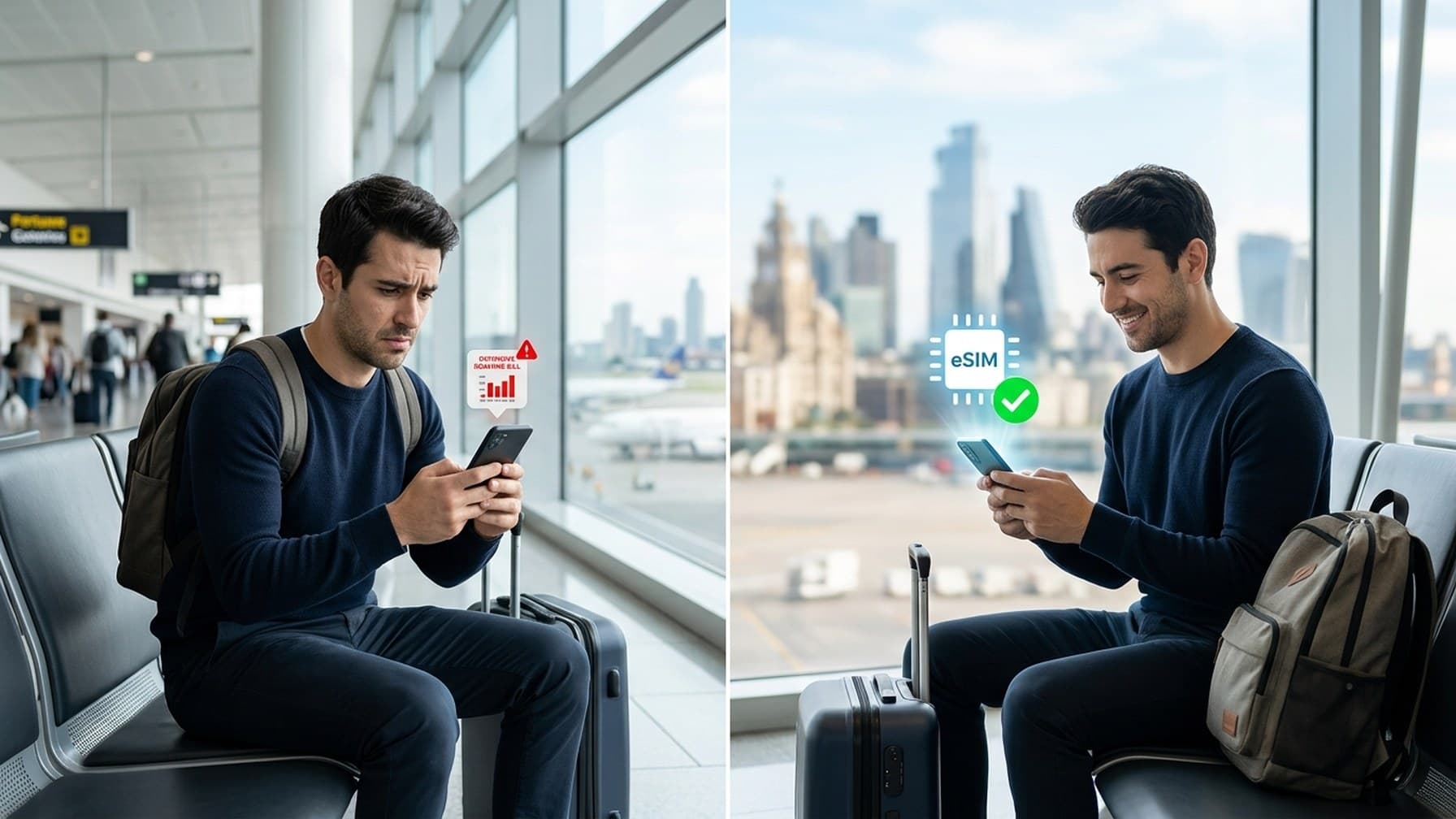
You land at a foreign airport, turn off airplane mode, and within seconds your carrier sends a text: "Welcome to Japan. Roaming rates apply." That moment costs most travelers somewhere between $10 and $15 every single day, whether they use their phone for one email or stream three hours of video. Switching to a travel eSIM before your next trip can cut that cost by 50 to 85 percent, while giving you better speed and zero surprise charges. Understanding exactly why that difference exists is what this guide is about.
At its simplest, the choice is between letting your home carrier charge you for borrowing a foreign network and buying your own prepaid data plan that connects you directly to local networks abroad. Travel eSIM providers like Roamix have made the second option genuinely easy, delivering an installation QR code to your inbox within 60 seconds of checkout. If you want to see what that looks like for your destination, Roamix covers 190+ countries with transparent, prepaid pricing at roamix.app.
The differences go deeper than price. Coverage quality, connection speeds, setup friction, and the ability to keep your regular phone number all factor into which option fits your trip. This guide covers each one honestly, including the rare cases where your carrier's daily roaming pass is actually the smarter call.
What You're Actually Choosing Abroad
Data roaming and travel eSIMs both put a signal on your phone abroad, but the underlying mechanics are completely different. One routes your data through your home carrier's partner agreements; the other places a fresh, local data profile directly onto your device.
How Carrier Data Roaming Works
When you enable international roaming, your home carrier arranges a wholesale agreement with a foreign carrier. Your phone latches onto that foreign network as a guest subscriber. Your carrier bills you a daily flat fee, typically $10 to $15 per day for US providers, regardless of how much data you consume.
The foreign network treats roaming subscribers differently from local subscribers. Traffic is frequently deprioritized, which means slower speeds during peak hours. You're also locked into whichever carrier your home provider has a deal with, even if a faster network exists in the same city.
How A Travel eSIM Works
A travel eSIM is a prepaid digital SIM profile that gets loaded directly onto your phone's embedded SIM chip. You purchase a plan from a provider like Roamix, receive a QR code by email, scan it to install the profile, and your phone is ready to connect the moment you land. No physical card, no carrier call, no airport kiosk.
Because the plan is prepaid, your total spend is set before you board. A 10GB regional plan for Europe costs a fixed amount upfront. There's no meter running daily, and no automatic overage charges if you burn through data faster than expected.
Why An eSIM Is Called An Embedded SIM
The "e" in eSIM stands for embedded. Unlike a traditional SIM card that slides in and out of a tray, an eSIM is a small chip soldered directly onto your phone's motherboard during manufacturing. It can store multiple carrier profiles simultaneously and switch between them in software without any physical change.
This is why eSIM-compatible phones can hold your home carrier profile and a Roamix travel profile at the same time. Both live on the same chip, and you choose which one handles data through your phone's settings.
The Real Cost Difference
The price gap between carrier roaming and prepaid eSIM plans is significant and consistent across destinations. For most trips longer than two or three days, a travel eSIM costs meaningfully less, and the savings compound quickly.
Why Roaming Fees Add Up So Fast
Roaming charges are structured as flat daily fees, not consumption-based prices. Verizon TravelPass, AT&T International Day Pass, and T-Mobile's daily roaming options all price in the $10 to $15 per day range for most international destinations. A seven-day trip costs $70 to $105 in roaming fees alone, before you consider whether you actually used data every single day.
The fee structure works against you even when you barely use your phone. A day spent on a long-haul flight, a beach day with the phone in your bag, or an evening at dinner still triggers the daily roaming charge the moment your phone connects to a foreign tower. There is no partial-day credit.
How Prepaid eSIM Plans Improve Cost Control
A prepaid travel eSIM like Roamix charges you for a data allowance, not for days of access. A 5GB plan for Japan might cost $15 total. That's the same as one day of Verizon TravelPass, but it covers the entire week. Roamix notes that travelers typically save 50 to 85 percent compared to traditional carrier roaming.
Prepaid also means no bill shock. You see the full cost at checkout, and your data simply stops when the allowance runs out. Roamix sends usage alerts at 50% and 80% of your allowance, so you can top up before hitting zero rather than getting caught off guard mid-trip.
When A Daily Pass Like Verizon TravelPass Still Makes Sense
Carrier daily passes are not always the wrong answer. If your trip is genuinely one or two days, the math can be close enough that the simplicity of staying on your existing carrier is worth the slight premium. The same logic applies when your company is reimbursing roaming costs and the administrative overhead of a new eSIM profile isn't worth it.
TravelPass also includes calls and texts on your existing number without any configuration, which matters for travelers who receive a high volume of calls rather than just using data. For a two-day business trip where calls are critical and data usage is light, the daily fee may be reasonable.
Coverage, Speed, And Network Performance
Coverage maps tell part of the story, but real-world performance depends on how your data is routed after it hits a local tower. That routing distinction is where carrier roaming and travel eSIMs begin to diverge in ways that daily fee comparisons don't capture.
Local Networks Vs Home-Carrier Routing
When you use carrier roaming, your data connects to a foreign network but is routed back through your home carrier's infrastructure before reaching the internet. That backhaul adds latency, sometimes significantly, because packets travel a much longer physical path. A request from Tokyo bounces across the Pacific before loading a local website.
A travel eSIM profile connects to the same local towers, but traffic exits to the internet locally. The result is lower latency and speeds that are closer to what local residents experience on the same network.
How Roaming Coverage Can Limit Performance
Roaming subscribers are often placed on a specific partner carrier, even if that carrier isn't the strongest in a given area. Your home provider's agreement doesn't automatically give you access to every network at your destination. In countries where the roaming partner has patchy rural coverage, you may find your connection drops where a local subscriber on a different carrier would have full bars.
Roaming agreements also change. A carrier that had strong coverage in Southeast Asia last year may have renegotiated its partner agreements since, leaving customers with degraded service and no advance notice.
Why Roamix's Global IP Breakouts Matter
Roamix addresses the routing problem with global IP breakouts, meaning your data exits to the internet at a local point of presence rather than being sent back through a distant server. In practical terms, this reduces latency noticeably for real-time apps like Google Maps navigation, Zoom, FaceTime, and anything that depends on low ping.
For travelers who rely on a laptop tethered to their phone for work, or who use navigation heavily in unfamiliar cities, this distinction matters more than raw download speed numbers suggest.
Setup, Compatibility, And Keeping Your Number
Getting an eSIM working on your device takes a few minutes when done correctly. The two things that trip people up most often are not checking device compatibility in advance and not understanding how dual-SIM mode handles calls versus data.
Checking If Your Phone Supports eSIM
Most smartphones released since 2018 support eSIM technology. On the iPhone side, that includes the iPhone XS and XR and every model released after, through the current iPhone 17 series. Android support includes Samsung Galaxy S20 and newer, Google Pixel 3 and newer, and most modern flagship devices from other manufacturers.
The fastest way to confirm eSIM support is to check your phone settings. On an iPhone, go to Settings, General, then About, and look for an EID number. On Android, the path varies by manufacturer but typically lives under Settings, About Phone, or SIM card manager. Roamix also provides a free eSIM Compatibility Checker on its website.
Why Your Device Must Be An Unlocked Phone
An unlocked phone is a prerequisite for using any third-party eSIM plan. Carrier-locked phones are restricted to profiles from the locking carrier, which means a Verizon-locked iPhone cannot install a Roamix eSIM profile, even if the device is technically eSIM-capable.
You can check lock status by inserting a SIM from a different carrier and seeing whether it connects. Alternatively, your carrier can tell you whether your device is locked and how to request an unlock if you've completed your contract term. Our guide on how to unlock your phone for an international eSIM walks through each step.
Using Dual SIM To Keep Your Regular Number Active
This is one of the most practical aspects of travel eSIMs that gets underexplained. When you install a Roamix eSIM profile, your home SIM stays in your phone and remains active. You assign Roamix as the data line and leave your home SIM handling calls and texts.
This means you keep your regular phone number, receive calls and SMS normally, and get all your iMessages and WhatsApp messages without any change to your contacts' experience. Your mobile data just runs through Roamix instead of your home carrier, which is what eliminates the roaming charges entirely.
When Roaming, Local SIMs, Or eSIMs Win
No single connectivity option wins every scenario. The right choice depends on your trip length, how many countries you're visiting, and how much data you realistically need.
Best Choice For Short Trips
For trips of one or two days, the calculation is genuinely close. If you're flying into a single city for a quick business meeting and data needs are minimal, a carrier daily pass like TravelPass avoids the small effort of installing a new eSIM profile. The cost premium is real, but the absolute dollar amount for two days is not enormous.
For trips of three days or longer, a prepaid travel eSIM almost always comes out ahead on cost. The break-even point against a $10/day roaming pass arrives quickly, and prepaid plans in most regions offer far more data for the same or lower total spend.
Best Choice For Multi-Country Travel
Travel eSIMs are clearly superior for multi-country itineraries. Roaming costs stack per country in many cases, or require a more expensive global roaming package. Buying a local SIM in each country means airport kiosks, passport checks, SIM swapping, and losing your number temporarily each time.
A regional eSIM plan from Roamix covers destinations like Europe across 30+ countries with a single purchase. The global plan extends to 130+ countries. You cross borders without touching your phone settings, and the connection switches to a local partner network automatically.
Best Choice For Long Stays And Heavy Data Use
For stays of two weeks or longer with heavy data needs, a local SIM card from a resident carrier is worth evaluating seriously. Local SIM pricing reflects what residents pay, which is often the cheapest per-gigabyte rate available. Providers like Airalo, Holafly, Saily, and Nomad all compete in the travel eSIM space and are worth comparing for specific long-haul destinations.
Where Roamix has a specific edge for heavy users is unlimited plans and free hotspot tethering. If you need to share data with a laptop or tablet throughout a long trip, avoiding a separate tethering fee adds up to meaningful savings versus competitors that charge extra for hotspot use.
Why Roamix Is The Better Switch For Travelers
Roamix was built by frequent travelers who experienced the same frustrations with roaming charges and airport SIM kiosks firsthand. The product decisions reflect that. Every feature is oriented toward removing friction and removing surprise costs.
How Roamix Cuts Costs Without Hidden Fees
Roamix operates as an MVNO, partnering with local carriers in 190+ countries to secure competitive data rates. Those savings pass through to prepaid plan pricing that undercuts traditional carrier roaming by 50 to 85 percent. A plan that replaces a week of $10/day roaming charges can cost less than $15 total for the same destination.
There are no contracts, no automatic overage charges, and no hidden fees layered onto the checkout price. What you see at purchase is the full cost. Payments are processed through Stripe with TLS encryption, and full card details are not stored on Roamix servers.
Instant Delivery, Top-Ups, And Unlimited Hotspot
Roamix generates your QR code and installation link within 60 seconds of payment and sends it by email. It also appears in your account dashboard, so it's accessible whenever you need it. Installation takes two to five minutes on Wi-Fi before you leave, and the plan activates automatically when your phone connects to a supported network at your destination.
If you run low on data mid-trip, instant top-ups are available directly through your Roamix account without reinstalling anything. All standard plans include unlimited hotspot tethering at no extra charge, which means you can run a laptop or tablet, or share with travel companions, from your phone's connection.
Who Roamix Fits Best, From Vacationers To Business Travelers
Casual vacationers benefit most from the simplicity: one purchase, one QR code, instant connectivity at the destination. There's no carrier negotiation, no airport queue, and no SIM to lose.
Business travelers and digital nomads gain from the account dashboard, which manages multiple eSIMs under one login, and from the unlimited plan options that remove any data anxiety during long trips. Roamix also supports corporate travel programs and bulk plan pricing for teams, making it a practical infrastructure choice for companies with frequent international travel.
Frequently Asked Questions
Is an eSIM better than using my carrier's international roaming plan?
For most trips, yes. A prepaid travel eSIM typically costs 50 to 85 percent less than carrier roaming, gives you a fixed upfront price with no surprise daily charges, and often delivers better speeds through direct local connections. The exception is a very short trip of one or two days, where simplicity may matter more.
Do I still need to enable roaming if I'm using an eSIM abroad?
Yes, but only on the eSIM line, not your home carrier line. Enabling data roaming on the eSIM lets the profile connect to partner networks at your destination. It does not trigger roaming charges because the eSIM is already a prepaid local or regional plan rather than an extension of your home carrier.
How do I use an eSIM on an iPhone abroad while keeping my home number?
Install the travel eSIM on your iPhone and set it as the default data line in your cellular settings. Leave your home SIM assigned to calls and texts. Your iPhone will use the eSIM for all data while incoming calls and SMS still arrive on your regular number throughout the trip.
What are the main disadvantages of using an eSIM when traveling?
Your phone must be eSIM-compatible and carrier-unlocked, which rules out some older or locked devices. Each eSIM is tied to one device, and the QR code cannot be reused once installed. Data-only plans include no local number, so calls go through apps like WhatsApp or FaceTime unless your plan includes voice.
Are eSIM data connections safe for banking and sensitive logins?
Yes. eSIM data is as safe as any other mobile data connection, and your banking app's own TLS encryption protects your session regardless of the network it travels over. A reputable VPN can add an extra layer of protection on any mobile or public connection. Roamix also uses bank-level TLS encryption for transactions.
How can I find a reliable unlimited eSIM plan for international travel?
Look for a provider offering genuine unlimited plans without throttling after a set threshold, hotspot tethering at no extra cost, and transparent pricing with no automatic overage charges. Roamix offers unlimited plans across 190+ countries with free hotspot tethering, usage alerts at 50% and 80% of your allowance, and 24/7 support while you travel.
More in International Roaming

Best Alternatives to Vodacom, MTN, and Telkom for International Roaming
South African carrier roaming bills can rival the cost of flights on a two-week international trip. This guide explains why Vodacom, MTN, and Telkom charges get so high and shows you the smartest alternatives available in 2026.
Best Alternatives to Telstra, Optus, and Vodafone for International Roaming
Australian carrier roaming fees can add hundreds of dollars to your travel bill. This guide compares travel eSIMs, local SIM cards, and carrier passes so you can find the cheapest way to stay connected overseas.

Rogers Roam Like Home Costs: Why Travel eSIMs Are Better
Rogers Roam Like Home charges up to 15 CAD per day, turning a 10-day trip into a 150 CAD phone bill before you count anything else. This guide breaks down when to use Rogers roaming versus a travel eSIM, and how to keep your Canadian number active for SMS without paying the daily fee.