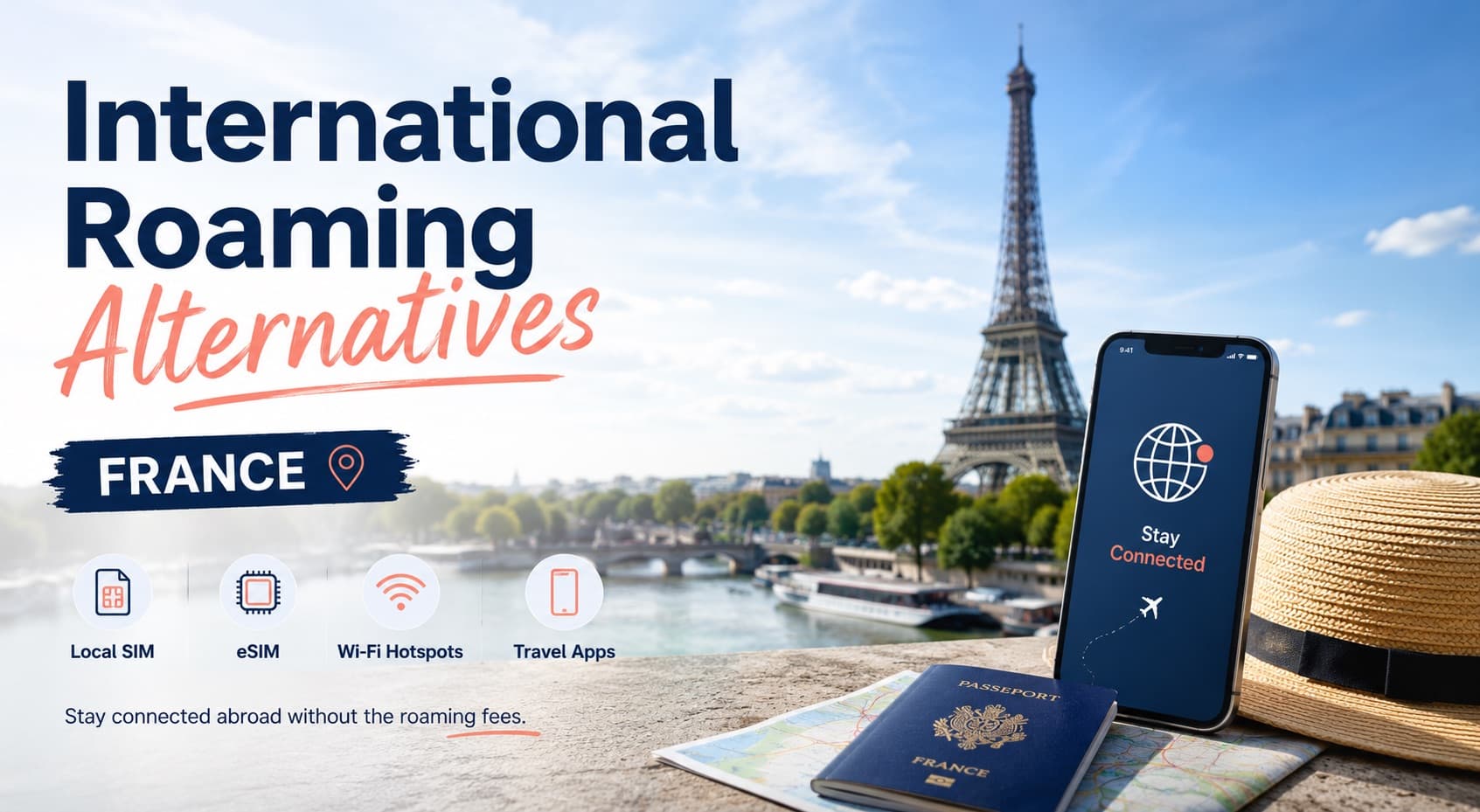
Best Alternatives to Orange, SFR, and Bouygues for International Roaming
On this page
If you live in France and travel regularly for work or leisure, you already know the anxiety that comes with checking your phone bill after an international trip.
Orange, SFR, and Bouygues Telecom all offer solid coverage at home, but the moment you cross outside Europe, their roaming fees can turn a week-long trip into a surprisingly expensive data bill.
Switching to a travel eSIM before you depart is one of the simplest ways to cut that cost by 50 to 85 percent without giving up your French number.
Services like Roamix, which covers 190+ countries and delivers your eSIM via QR code within 60 seconds of purchase, exist precisely to solve this problem for outbound travelers.
This guide is written for French residents heading abroad, whether for a city break in New York, a business trip to Tokyo, or a long-haul journey through Southeast Asia.
It breaks down what your home carrier actually charges outside the EU, when a travel eSIM makes the most financial sense, and how to set everything up before you even reach the airport.
Head to roamix.app to check compatibility and browse country or regional plans before your next departure.
What French Travelers Should Use Instead Of Carrier Roaming
Your connectivity options outside France range from enabling your home carrier's roaming pass to buying a local SIM on arrival.
You can also use a travel eSIM or rely on Wi-Fi with calling apps.
Each option suits a different type of trip, budget, and traveler.
Why Roaming Passes Stop Making Sense Outside Europe
Within the EU, French carriers are required to honor roam-like-at-home rules.
You use your existing data allowance in Germany, Spain, or Portugal without extra charges.
That protection disappears the moment you fly to the United States, Japan, or anywhere outside the EU/EEA zone.
Outside Europe, Orange, SFR, and Bouygues Telecom typically switch to daily travel passes or pay-per-use rates.
Daily passes often land between $10 and $15 per day, which adds up to $70 to $105 for a one-week trip.
For a two-week holiday, you could easily spend more on roaming than on your flights.
When A Travel eSIM Is The Best Choice
A travel eSIM is the strongest option for most international trips.
You purchase a data-only eSIM plan tied to your destination or region, install it on your phone before departure over Wi-Fi, and it activates automatically when you land.
Travel eSIMs are especially useful when:
- You are traveling outside Europe where EU roaming rules do not apply
- Your trip covers multiple countries and you want one plan for all of them
- You want predictable costs with no surprise charges
- You need data immediately on arrival without hunting for a SIM vendor
A global eSIM from a provider like Roamix also lets you keep your French SIM active in the background for incoming calls and texts, which is something a local SIM card cannot offer.
When A Local SIM Card Still Makes Sense
Buying a local prepaid SIM at your destination still makes sense in specific situations.
If you are staying in one country for several weeks, a local SIM often offers the cheapest per-gigabyte rates and may include local calls.
Countries like Japan, India, and the United States have competitive prepaid SIM options available at airports or convenience stores.
The trade-off is that you lose your French number while the local SIM is active, and setup can take time, especially if you need to show a passport or navigate a foreign-language interface.
When Wi-Fi And WiFi Calling Are Enough
For very short trips where you barely leave the hotel or conference venue, relying entirely on Wi-Fi is a reasonable cost-saving approach.
Apps like WhatsApp, FaceTime, and Zoom work well on stable Wi-Fi, and most hotels, cafes, and transport hubs in major cities offer free connections.
Wi-Fi calling through your French carrier can also let you receive calls on your French number without roaming charges, provided your carrier supports it and the Wi-Fi connection is reliable.
The main limitation is obvious: the moment you step outside or need navigation on the go, you need mobile data.
How Orange, SFR, Bouygues Telecom, And Free Mobile Compare Abroad
France's four main carriers each handle international roaming differently, but they share a common weakness.
Costs outside the EU rise sharply and can catch travelers off guard.
Understanding exactly how their pricing works helps you make a clear-eyed comparison before you commit to any option.
How Daily Roaming Fees Add Up On A Trip
Orange, SFR, and Bouygues Telecom all offer international roaming passes for travel outside Europe, typically structured as a flat daily fee that activates the moment you use data, make a call, or send a text abroad.
A typical daily pass from a French carrier for destinations like the United States or Japan runs between roughly 10 and 15 euros per day.
Here is what that looks like across different trip lengths:
| Trip Length | Daily Rate (€10) | Daily Rate (€15) |
|---|---|---|
| 3 days | €30 | €45 |
| 7 days | €70 | €105 |
| 14 days | €140 | €210 |
| 30 days | €300 | €450 |
These fees do not always include generous data allowances either.
Some passes cap data at a few hundred megabytes per day before throttling speeds significantly.
Europe Vs Outside-Europe Rules For French Plans
EU roaming rules are genuinely useful.
When you travel within the EU and EEA, roaming in France essentially means you use your domestic plan as normal.
Orange, SFR, Bouygues Telecom, and Free Mobile all honor this.
The protection ends cleanly at the EU border.
The United Kingdom, Switzerland, the United States, Canada, Japan, Australia, and most of the world outside the EU are subject to entirely different, far more expensive rate structures.
Free Mobile is sometimes cited as offering slightly more permissive international inclusions on certain plans, but it remains the exception rather than the rule.
Why Pay-Per-Use Rates Are The Riskiest Option
If you travel without activating a roaming pass or day pass, your French carrier may apply pay-per-use data rates instead.
These rates can reach several euros per megabyte, meaning a single hour of maps and messaging could cost more than an entire week of a travel eSIM plan.
Pay-per-use roaming is the worst financial outcome for any traveler.
Even an expensive daily pass from your home carrier is preferable to unmanaged pay-per-use data.
A travel eSIM purchased in advance eliminates this risk entirely.
Why A Travel eSIM Is Usually The Smartest Option
For French residents traveling outside Europe, a travel eSIM consistently offers the best combination of cost, convenience, and flexibility.
The core advantages span setup speed, number management, suitability for complex itineraries, and the choice between fixed data allowances and unlimited plans.
Instant Setup Before Departure
One of the most practical advantages of a travel eSIM is that installation happens before you leave home.
You purchase the plan, receive a QR code by email, and scan it to add the eSIM profile to your phone over Wi-Fi.
The whole process typically takes between two and five minutes.
When you land at your destination, the eSIM connects automatically to a supported local network.
There is no queue at an airport SIM kiosk, no passport check required for a local SIM purchase, and no frantic setup in an arrivals hall with a dying phone battery.
With an unlocked phone and an eSIM-compatible device, you are ready before you even board.
Keeping Your French Number With Dual SIM
Dual SIM capability is one of the most underrated features of modern smartphones, and it is the reason a travel eSIM works so well for French travelers specifically.
Your physical French SIM stays in the phone and remains active for incoming calls, SMS messages, and two-factor authentication codes.
The eSIM handles all mobile data.
This means colleagues, family, and banks can still reach you on your regular French number.
You do not need to forward calls or explain to anyone that you have a temporary number.
Roamix is built with dual SIM use in mind for this reason.
Better For Multi-Country And Long-Haul Trips
If your trip crosses multiple borders, a regional or global eSIM is far more practical than juggling local SIMs or paying daily roaming fees per country.
A single Europe eSIM covering 30+ countries removes the need to manage connectivity every time you cross a border.
A global eSIM covering 130+ countries works for frequent travelers who move between continents regularly.
With carrier roaming, each country may trigger a new daily charge.
With a multi-country eSIM, you pay once and move freely.
Data-Only Plans Vs Unlimited Data eSIM Options
Travel eSIMs come in two main flavors: fixed data plans and unlimited data plans.
- Fixed data plans (1GB, 5GB, 10GB, etc.) work well for light to moderate use: navigation, messaging, and occasional browsing. They are typically the lowest-cost entry point.
- Unlimited data eSIM options suit heavy users who stream video, use video calls frequently, or share a hotspot with a laptop or tablet.
Roamix offers both, including unlimited plans designed for travelers who need complete peace of mind without tracking every megabyte.
How Roamix Helps French Residents Stay Connected Worldwide
Roamix was built specifically to replace expensive carrier roaming with instant, affordable mobile data for international travel.
For French residents, that means a practical alternative the moment your Orange, SFR, or Bouygues Telecom plan stops being cost-effective outside Europe.
Coverage, Speed, And Global IP Breakouts
Roamix covers 190+ countries and territories, with 4G LTE available across covered destinations and 5G where local infrastructure supports it, including the United States, United Kingdom, Japan, Germany, Singapore, South Korea, Australia, and France.
A feature that genuinely sets Roamix apart is its global IP breakout architecture.
Rather than routing your data traffic back through a server in another region, Roamix connects you to the nearest local network point.
The practical effect is lower latency, faster load times, and a more responsive connection, especially noticeable on video calls and navigation apps.
Top-Ups, Hotspot Use, And Usage Alerts
Running low on data mid-trip is a real concern, and Roamix addresses it directly.
You can add more data instantly through your Roamix account dashboard without reinstalling the eSIM or going through any additional setup.
Usage alerts trigger automatically at 50% and 80% of your data allowance, so you are never caught off guard.
There are no automatic overage charges.
All standard Roamix plans include hotspot tethering at no extra cost.
You can share your mobile data connection with a laptop, tablet, or a travel companion's device, which is useful both for remote work and for family trips.
Who Roamix Fits Best: Holidays, Work Trips, And Digital Nomads
Roamix suits a wide range of French travelers:
- Holiday travelers heading outside Europe who want simple, affordable data without daily carrier fees.
- Business travelers crossing multiple countries in a single trip who need reliable connectivity without administrative complexity.
- Digital nomads and remote workers who need consistent data, hotspot capability, and the ability to keep their French number active for professional contacts.
- Frequent flyers who want one trusted eSIM provider for every destination rather than researching local options for each trip.
The 24/7 human support and 14-day refund window on unactivated plans also provide reassurance for first-time eSIM users.
Roamix Vs Local SIMs, Airport SIMs, And Other eSIM Providers
Choosing between Roamix and the alternatives comes down to price, convenience, and flexibility. The main competitors are other travel eSIM providers like Airalo, Holafly, and Saily, as well as physical SIM options and carrier day passes.
Roamix Vs Airalo, Holafly, And Saily
All four are legitimate travel eSIM providers, but they differ in meaningful ways.
| Provider | Key Strength | Limitation |
|---|---|---|
| Roamix | Global IP breakouts, unlimited hotspot, 24/7 human support, 190+ countries | Premium pricing tier |
| Airalo | Large marketplace with many plan options | No global IP breakouts; support is less hands-on |
| Holafly | Unlimited data plans available | Generally higher price point for equivalent data |
| Saily | Low entry price | Fewer support resources; limited plan flexibility |
Roamix's combination of local IP routing, included hotspot on all plans, and round-the-clock human support makes it a strong option for travelers who prioritize reliability.
Roamix Vs A Local French SIM Or Prepaid SIM Abroad
A local French SIM from Orange or SFR is your best option inside France, where you get full domestic rates and coverage.
Abroad, it becomes the source of the problem rather than the solution.
A prepaid SIM purchased at your destination can offer competitive local rates, but you give up your French number, spend time finding a vendor, and deal with potential language barriers.
For multi-country trips, you repeat this process at each border. Roamix sidesteps all of that.
Roamix Vs Carrier Day Passes From Home
Carrier day passes from Orange, SFR, or Bouygues Telecom are the most expensive option in most scenarios.
At 10 to 15 euros per day, even a week-long trip costs more than most Roamix plans. Day passes also typically throttle data after modest daily limits.
The one scenario where a carrier day pass wins is convenience for a single overnight trip where you forget to plan ahead.
For any trip longer than two or three days, the cost savings from Roamix are difficult to ignore.
How To Choose The Right Setup For Your Next Trip
Picking the right connectivity option is not complicated once you match your trip type to your actual usage needs.
Four practical questions cover most scenarios: how long you are traveling, how many countries you are visiting, how much data you expect to use, and whether your device is eSIM-ready.
Best Option For Short Trips
For a trip of three to five days to a single destination outside Europe, a country-specific travel eSIM from Roamix is usually the most cost-effective and straightforward choice.
You purchase before departure, install over Wi-Fi at home, and arrive connected.
A carrier day pass is the main alternative but will almost certainly cost more.
A local prepaid SIM is an option for very budget-conscious travelers, but the setup friction rarely justifies the marginal savings on a short stay.
Best Option For Multi-Country Travel
If your trip spans multiple countries or regions, a regional eSIM or global eSIM removes the biggest headache of cross-border travel.
Roamix offers regional plans covering areas like Europe, Asia, and the Americas, plus a global plan covering 130+ countries.
Rather than activating a new day pass or buying a new SIM at each border, you cross freely with the same plan active throughout.
Business travelers moving through multiple markets in a single week benefit most from this setup.
Best Option For Heavy Data Users
Heavy data users, defined by regular video streaming, frequent video calls, or consistent hotspot sharing with other devices, should look at unlimited data eSIM plans.
Roamix's unlimited options provide complete predictability: one flat cost, no throttling anxiety, and hotspot included at no extra charge.
Fixed data plans are fine for light use, but if you are working remotely or sharing data with a family member's tablet, unlimited is worth the slightly higher cost.
What To Check Before You Buy
Before purchasing any travel eSIM, confirm the following:
- Device compatibility: your smartphone must be eSIM-capable. Roamix supports iPhone XS and newer, Samsung Galaxy S20 series and newer, Google Pixel 3 and newer, and most modern flagship Android devices.
- Carrier unlock status: your phone must be carrier-unlocked. Locked devices cannot activate a third-party eSIM.
- Destination coverage: check that your chosen plan covers every country on your itinerary. Do not just check the first stop.
- Data allowance: use a data calculator to estimate your needs before buying. Consider navigation, streaming, and hotspot use.
- Installation timing: install your eSIM before departure on a stable Wi-Fi connection. Do not leave it until the airport.
Roamix's free eSIM Compatibility Checker and Data Calculator at roamix.app make this pre-trip checklist quick to work through.
Frequently Asked Questions
Do Orange and SFR roaming charges apply inside the EU?
Within the EEA, Roam Like at Home rules mean French travelers can use their domestic data allowance without extra charges across EU member states. Outside the EEA, commercial international rates apply. Countries like the US, UK, Japan, and Australia all fall outside these protections, where daily pass or per-MB rates take over.
Can I keep my French number active while using a travel eSIM abroad?
Yes. On a dual-SIM device, your Orange, SFR, or Bouygues physical SIM stays active for calls and texts while your travel eSIM handles mobile data. Your French number remains reachable for bank verification codes, family contact, and professional calls throughout the trip without triggering carrier data roaming fees.
When does an Orange or SFR roaming pass make more sense than a travel eSIM?
Carrier roaming passes make sense for very short trips of one or two days outside the EU where you primarily need voice calls rather than heavy data. For anything longer, the daily fee structure becomes expensive. A two-week trip to the US at a typical daily rate adds up to well over what a travel eSIM would cost for the same duration.
What is the best travel eSIM plan for French travelers visiting multiple countries?
For multi-country trips, a regional eSIM plan removes the need to buy separate plans for each destination. Roamix offers regional plans covering Asia, North America, the Middle East, and Africa under a single purchase. For very broad itineraries, the global plan covering 130 countries handles everything without repeated plan management across borders.
More in International Roaming

Best Alternatives to Vodacom, MTN, and Telkom for International Roaming
South African carrier roaming bills can rival the cost of flights on a two-week international trip. This guide explains why Vodacom, MTN, and Telkom charges get so high and shows you the smartest alternatives available in 2026.
Best Alternatives to Telstra, Optus, and Vodafone for International Roaming
Australian carrier roaming fees can add hundreds of dollars to your travel bill. This guide compares travel eSIMs, local SIM cards, and carrier passes so you can find the cheapest way to stay connected overseas.

Rogers Roam Like Home Costs: Why Travel eSIMs Are Better
Rogers Roam Like Home charges up to 15 CAD per day, turning a 10-day trip into a 150 CAD phone bill before you count anything else. This guide breaks down when to use Rogers roaming versus a travel eSIM, and how to keep your Canadian number active for SMS without paying the daily fee.